27 Apr
Open banking for e-commerce: what it is, the PSD2 regulations and the benefits for Italian merchants
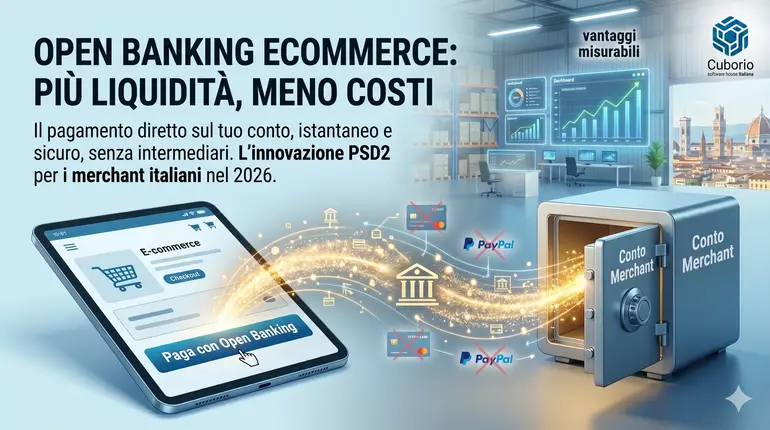
Open banking allows an e-commerce business to collect payments directly from the customer’s bank account, without going through credit cards, PayPal or other intermediaries. The transfer takes place in real time, the fee is fixed and much lower than with traditional methods, and the money arrives in the merchant’s account within seconds.
For an Italian B2B e-commerce business handling high-value recurring orders, orders based on quotes, or customers with trade credit, open banking is not a futuristic option: it is already available, regulated by the European PSD2 directive, and already integrated into various payment platforms operating in Italy, such as our Cuborio.
What is open banking and how does it differ from PayPal or Stripe?
Open banking is a payment system that uses banking APIs to allow authorised third parties — known as PISPs (Payment Initiation Service Providers) — to initiate a payment directly from a user’s bank account, with their explicit consent, without their bank details ever being shared with the merchant.
In practice, it works like this: the customer reaches the checkout of your e-commerce site, selects ‘Pay with open banking’, is redirected to their bank (or the banking app on their phone), authorises the payment using their bank credentials or biometric authentication, and the money is transferred immediately to the merchant’s account. No credit card, no PayPal account, no intermediary holding the funds for days.
Compared to PayPal: PayPal is a digital wallet that acts as an intermediary between the buyer and the merchant. Funds pass through PayPal accounts and may be held in the event of a dispute. Open banking is a direct bank transfer: funds arrive in the merchant’s account without any intermediate stops and without a third party being able to block them unilaterally.
Compared to Stripe (credit cards): Stripe and card gateways typically charge percentage-based fees of between 1.5% and 2.9% plus a fixed fee per transaction, as well as holding funds for one or more working days before crediting them. Open banking has much lower fixed fees (often under 50 pence per transaction, regardless of the amount) and immediate settlement.
Compared to traditional bank transfers: a standard SEPA transfer takes 1–2 working days. Open banking via SEPA Instant Credit Transfer takes less than 10 seconds, 24 hours a day, 7 days a week, including public holidays.
According to data from the Bank of Italy, in 2024 open banking transactions in Italy exceeded 45 million, representing a 78% increase on the previous year. The market is still in a phase of rapid growth, which means that those who adopt it today are building a competitive advantage over competitors who are waiting.
What does the PSD2 directive entail and what changes for Italian e-commerce businesses?
PSD2 (Payment Services Directive 2) is the European directive that has made open banking possible and regulated it. Transposed into Italian law by Legislative Decree 218/2017 and subsequent provisions of the Bank of Italy, it stipulates that banks are obliged to open their APIs to authorised third parties (such as PISPs), guaranteeing users the right to access their funds through any regulated payment service, not just their own bank.
For an Italian merchant running an e-commerce business, PSD2 has introduced two concrete changes.
The Strong Customer Authentication (SCA) requirement
From September 2021, PSD2 requires that every online payment be authenticated using at least two of the following factors: something the customer knows (password, PIN), something they possess (smartphone, token), or something they are (fingerprint, facial recognition). This has made 3D Secure mandatory for card payments and has increased checkout abandonment rates — one of the main reasons why many Italian merchants are considering alternatives.
Open banking natively meets the SCA requirement: bank authentication using biometrics or a PIN satisfies the Strong Customer Authentication requirements without adding extra steps for the customer. In many scenarios, checkout via open banking is perceived as smoother than checkout with a card + 3D Secure.
The right to access banking APIs
PSD2 requires banks to provide standardised APIs to third parties authorised by the Bank of Italy. This has created the technical and regulatory infrastructure on which the entire open banking ecosystem is based. In Italy, all the major banks (Intesa Sanpaolo, UniCredit, Banco BPM, BPER, Crédit Agricole and over 200 smaller institutions) have implemented the APIs required by the directive, making open banking accessible to the vast majority of Italian account holders.
It should be noted that PSD2 does not make open banking mandatory for merchants: no e-commerce business is obliged to accept it. It is a commercial choice that depends on the customer profile and the type of transactions handled. That said, ignoring it in 2026 means missing out on a real opportunity to reduce transaction costs and improve liquidity.
What are the benefits of open banking for SMEs selling online in Italy?
The benefits of open banking for an Italian e-commerce business are tangible and measurable, not theoretical. The most significant ones for an SME relate to transaction costs, payment processing times and security.
Reduction in transaction costs
This is the most immediate benefit. Credit card fees average between 1.5% and 2.9% of the transaction value, plus a fixed fee per transaction. For a B2B e-commerce business processing €500,000 worth of orders per month, this amounts to between €7,500 and €14,500 in monthly fees for payment costs alone.
Open banking operates on a fixed-fee basis, typically between 20 and 50 cents per transaction, regardless of the amount. For high-value B2B transactions (orders of €1,000, €5,000, €10,000), the savings compared to a credit card are proportional to the amount and can be very significant.
Immediate liquidity
With credit cards, funds are typically credited to the merchant’s account with a delay of 1–3 working days, after the gateway has carried out its checks. With open banking and SEPA Instant, funds are in the merchant’s account in under 10 seconds, even on Saturdays, Sundays and public holidays.
For a high-volume e-commerce business, having immediate liquidity rather than waiting 2–3 days can make a real difference to working capital management, especially during peak periods such as Black Friday, Christmas or promotional campaigns.
Elimination of fraudulent chargebacks
A chargeback is the mechanism by which a customer disputes a credit card payment and requests a refund from their bank. The merchant is automatically refunded and must prove that the transaction was legitimate — a lengthy and costly process. In sectors with a high risk of fraud, chargebacks can account for 1–3% of turnover.
With open banking, chargebacks do not exist. The payment is authorised directly by the user via their bank using strong authentication: once authorised, it cannot be disputed as fraudulent. Disputes are handled directly between the merchant and the customer, without the involvement of the card-issuing bank.
Suitable for high-value B2B orders
Credit cards have spending limits that make it difficult to use them for large B2B orders. A wholesaler ordering €8,000 worth of goods from their supplier cannot pay by card — corporate credit limits rarely cover this type of transaction. Open banking has no card-related spending limits: the limit is simply the available balance in the customer’s bank account.
To learn more about how to optimise the entire payment experience and boost checkout conversions, the guide on how to increase revenue by optimising the payment experience offers strategies you can implement immediately.
How is open banking technically integrated into an existing e-commerce site?
Open banking is integrated into an e-commerce site via the APIs of a PISP — a Payment Initiation Service Provider authorised by the Bank of Italy. The PISP acts as a bridge between your e-commerce site and the banking APIs of your customers’ banks.
The technical flow of an open banking payment in an e-commerce platform is as follows. The customer selects ‘Pay with open banking’ from the available payment methods. They select their bank from the list of supported banks, which in Italy cover over 95% of account holders. They are redirected to their bank’s interface (web or mobile app) and log in using their bank credentials. They view the payment details (amount, beneficiary, reference) and confirm. The bank notifies the PISP of the successful authorisation, the PISP notifies your e-commerce platform that the payment has been authorised, and the SEPA Instant transfer arrives in the merchant’s account in under 10 seconds.
From the merchant’s perspective, integration involves adding the payment method to the checkout, configuring the destination IBAN for payments, and integrating webhook notifications to update order statuses in real time.
To learn more about how the digital payments ecosystem works and which trends are emerging, the article on the future of e-commerce payments amid innovations and trends offers an up-to-date overview of the sector.