29 Dec
E-commerce 2026: Multichannel Strategies and Integrations Cuborio
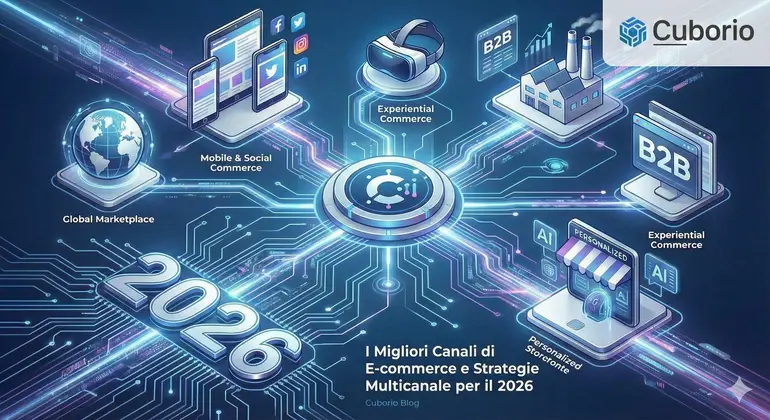
If you are reading this guide, you are probably looking to expand your online business, but you are faced with an increasingly complex choice: where to sell? Your own website, marketplace, social media, mobile app? The answer, for 2026, is not 'one', but 'many, in a coordinated way'.
E-commerce is no longer a one-way street, but a real ecosystem. Industry studies indicate that customers who interact with a brand on three or more channels have significantly higher lifetime value and greater loyalty.
Cuborio'se-commerce consultants have prepared this practical 3-point guide to successfully navigating the multichannel era, identifying the most promising e-commerce channels for the coming year, and building an integrated strategy that reduces complexity and maximises results for your business.
What are e-commerce channels? The foundation of your online success in 2026
To build a winning strategy for your e-commerce business, let's start with the basics. An e-commerce channel is any digital touchpoint through which a customer can discover, interact with and ultimately purchase a product or service.
We can divide them into two macro-categories:
- Direct (or Proprietary) Channels: These are the ones you have full control over. The main one is your proprietary e-commerce website, the true heart of your digital presence. It is your main showcase, where you define the customer experience, own all the data and build a direct relationship with your audience. Equally important are dedicated mobile apps, which offer an optimised, 'always at your fingertips' experience, facilitating push notifications and quick purchases.
- Indirect (or Third-Party) Channels: These are platforms owned by other parties on which you decide to be present in order to reach their large, established audience. This category includes multi-vendor marketplaces (where multiple sellers offer products in a single virtual location) and social commerce platforms, which integrate direct purchasing functionality within social networks.
The choice betweenB2B (Business-to-Business) and B2C (Business-to-Consumer) e-commerce strongly influences the selection of channels. B2B strategies often favour proprietary websites with complex features (customised price lists, wholesale order management) and specialised vertical marketplaces. B2C, on the other hand, ranges more widely between proprietary websites, generalist marketplaces and social commerce, aiming for maximum visibility and ease of purchase.
That's why we can't overlook the dominant role of m-commerce (mobile commerce). Today, most online visits and purchases are made via smartphones. Every channel, from your website to your social media experience, must be designed first and foremost to be perfect on mobile: intuitive interfaces, lightning-fast loading times and simplified checkout.
The best e-commerce channels for 2026: a strategic overview
2026 looks set to be a year in which smart diversification will be key. It's not about being everywhere at all costs, but about choosing the channels that align with your business and your ideal customer.
The table below provides a summary to help you navigate.
| Channel | Key Advantages | Challenges to Consider | Ideal for... |
Website Owner (DTC) | Total control, higher margins, brand building, customer data ownership. | Requires investment in traffic acquisition (SEO, ads) and maintenance. | All companies that want to build a of long-term value and a direct relationship with the customer. |
Multivendor Multivendor | Access to a vast, ready-made audience, payment/logistics infrastructure often included, rapid scalability. | Fierce competition, commissions on sales, less control over experience and data. | Companies that want to test products, clear stock or reach new markets quickly. |
Social Commerce | Selling where people already spend their time, a visual and engaging approach, precise advertising targeting. | Shopping experience sometimes fragmented, variable algorithms, particularly suitable for visual/impulse products. | Brands with a strong visual identity and active community, especially in fashion, beauty, and food. |
Mobile App Dedicated | Optimised user experience, push notifications for engagement and repurchase, icon always on the device. | Development and maintenance costs, need to persuade the user to download it. | Businesses with high purchase frequency or offering subscription services (loyalty programmes). |
Let's now analyse each channel in detail.
Your proprietary website: your digital headquarters
Your e-commerce site is not just a channel, it is your brand's digital home. In 2026, being "DTC" (Direct-to-Consumer) means much more than selling online: it means creating a consistent experience, telling your story, gathering valuable insights and building customer loyalty.
It is the only place where you can offer a fully personalised shopping experience, set up sophisticated loyalty programmes and showcase your full range of products without competitive distractions. To make it successful, it must be responsive, SEO-optimised and built on a solid, scalable technology base that grows with you.
Multivendor marketplaces: the lever for scalability
Marketplaces are a powerful lever for growth. They allow you to 'lean' on the established traffic and trust of a giant platform, reaching millions of potential customers with minimal initial marketing effort. They are ideal for increasing the visibility of a new brand, testing demand for new products in different markets or selling high volumes. The challenge is to stand out in a sea of competition and accept giving up some of your margin in exchange for visibility. To maximise their potential, it is crucial to take great care with product listings (with professional images and detailed descriptions) and manage customer reviews with extreme precision.
Social Commerce: selling in the social ecosystem
Social commerce is evolving from simple discoveryto complete in-app purchase. Imagine a customer who sees a video of your product on a social network, clicks on a tag, views details and reviews, and completes the purchase without ever leaving the app. This is the immediate future. This channel leverages the power of visual content (videos, reels, live shopping) and digital word-of-mouth, turning followers into customers and customers into promoters. The winning strategy for 2026 integrates authentic and engaging content with direct sales capabilities, creating a seamless journey from inspiration to transaction.
Other emerging channels to watch in 2026
- PWA (Progressive Web App): Progressive Web Apps offer an app-like experience (home screen icon, offline functionality) but are accessible directly from the browser, without downloading. An excellent compromise between a website and a native app.
- Sales through online bookings: For services, restaurants, experiences. Integrating a booking and payment system into your e-commerce is a form of e-commerce in its own right.
- Hybrid Models (Dropshipping, Subscription Box): dropshipping can be activated through different channels (your own website or marketplace) and responds to specific market needs such as convenience or recurring discovery.
How to build an effective multichannel strategy for your e-commerce
Having multiple channels is not a strategy. A multi-channel strategy is the art of making them work together synergistically, creating a single, cohesive experience for the customer, regardless of where they interact with you. Here are the basic steps our computer engineers take every time they design a new e-commerce site.
1. Analysis and planning: start with your business and your customer
Ask yourself: Who is my ideal customer? On which channels do they search for products like mine? What are my goals (visibility, conversions, loyalty)? Assign a specific role to each channel: the website as the main hub for profit and brand, the marketplace for volume and acquisition, social media for engagement and discovery.
2. Synchronisation and integration: the technological heart
This is the biggest operational challenge. A central system (often your main e-commerce platform) must communicate in real time with all other channels through API connectors. In practice:
- Unified Inventory Management: The quantity of a product sold on a marketplace is automatically updated on your website and in your management system, avoiding unpleasant "sold out" situations and overselling.
- Centralised Orders: All orders, from any channel, converge in a single control panel for logistics and customer service management.
- Consistent Customer Data: Customer information can be synchronised (in compliance with privacy regulations) to offer a more personalised service.
Without this integration, management becomes a nightmare of Excel spreadsheets and manual errors.
3. Brand consistency and consistent user experience (UX)
Your logo, colour palette, tone of voice and image quality must be recognisable from your website to your marketplace page to your social media profile. The post-purchase experience (confirmation, tracking, returns) should also be as similar as possible. The customer must feel that they are interacting with the same reliable and professional company.
4. Optimisation for visibility and acquisition
Each channel has its own rules:
- Own website: Invest in technical SEO and content to attract long-term organic traffic.
- Marketplace: Optimise product listings with searched keywords and high-quality images.
- Social media: Use platform-native content (short videos, reels) and highly segmented advertising to drive traffic to your points of sale.
5. Leverage 2026 trends: AI, personalisation and sustainability
- Generative Artificial Intelligence: In addition to analysis, generative AI will become an operational tool in 2026 for creating product descriptions, customer service responses and personalised marketing content based on your data.
- Hyper-Reactive Personalisation: Display product recommendations based on past behaviour, send tailored offers, and make every interaction relevant to the individual customer.
- Sustainability as a Transparent Value: In 2026, communicating product lifecycle, carbon footprint and recycling policies in a detailed and verifiable manner will be a powerful differentiator for an increasingly informed audience.
6. Overcoming multichannel challenges: practical solutions
The multichannel path is not without obstacles. Here's how to address the most common challenges:
- Data and management fragmentation: The solution lies in a centralised, flexible e-commerce platform that acts as a single 'brain'. A platform with a modular architecture and robust APIs allows you to connect and govern all channels from a single dashboard, transforming complexity into control.
- Costs and operational complexity: Instead of using multiple separate software programmes (one for the website, one for inventory, one for marketplaces), look for an integrated solution that consolidates key functions. This reduces licensing and training costs and errors.
- Logistics and inventory management: Integrate your e-commerce system with your enterprise resource planning (ERP) software and logistics partners. Automation is key to fulfilling orders quickly, regardless of their origin.
- Maintain consistency: Create clear brand guidelines and share them with the whole team. Use content management tools that allow you to easily adapt graphic and text materials to different channels while maintaining a strong identity.
Transform your e-commerce into an omnichannel platform with Cuborio
Building a successful multichannel e-commerce presence in 2026 is not a sprint, but a strategic marathon. It requires careful planning, intelligent channel selection and, above all, core technology that acts as the glue for the entire ecosystem. Your proprietary website remains the cornerstone of your digital sovereignty, while marketplaces and social commerce are powerful levers for accelerating growth.
The real competitive differentiator will not be having a presence on one more channel, but the ability to offer a seamless, consistent and personalised shopping experience across all touchpoints. This is what builds loyalty, increases average order value and turns occasional customers into brand ambassadors.
Ready to turn the complexity of multichannel into your greatest advantage? Choosing the right technology platform is the first decisive step.